


Demonstrations
Demonstrations
The TECHNOSEUM is a living museum. People and machines belong together, which is why historical working conditions are best experienced first-hand. Our demonstration technicians pull out all the stops at the steam engine, demonstrate how a mechanical weaving mill works, or turn grain into flour in the grain mill. Best of all, there are plenty of stations where you can get hands-on and, for example, make your own paper.
You can find the times of our demonstrations in the daily programme:
Railway
Railway
The historic steam locomotive, dating from 1896, departs several times a day from the museum station on Level E for a journey to the open-air exhibition area. The locomotive has been converted for museum use, so that the steam is now stored in a fireless boiler on board the train. In the third-class carriage from 1887, you can experience first-hand what a train journey felt like in the late 19th century. All aboard!
Peat Railway
Peat Railway
Our steam-powered museum locomotive has a little sister with a diesel engine: the former peat railway entered service in 1961 and now makes its rounds on the track, which is around one kilometre long, through the museum park. All aboard!
Trips are cancelled in the event of rain.
There are currently no trips available on the light railway!
Coin-making Station
Coin-making Station
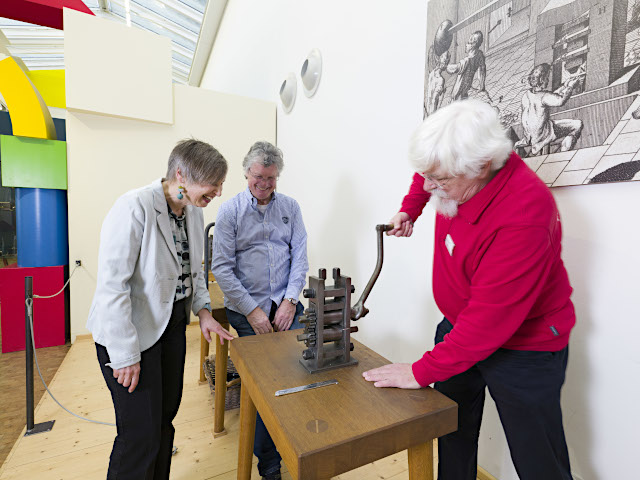
At our coin-making station, we demonstrate how coins were once painstakingly produced by hand. Our dedicated volunteers run this demonstration station and look forward to your visit!
Steam Engine
Steam engine
We’ll be demonstrating live how a steam engine works, as the pistons and flywheel of our steam engine start to move. It took up to six tonnes of steam at 275°C per hour to generate 550 kilowatts – roughly the power output of two top-of-the-range engines.
Weaving Mill
Weaving Mill
How was work carried out in the textile industry in the 19th century? We demonstrate this in our historic weaving mill, complete with a waterwheel and a drive shaft, which illustrates the transition from manual to machine-based work.
Paper-making
Paper-making
Let’s get to the paper-making vat! It’s time to roll up your sleeves and use the sieve to form and press a sheet of paper by hand. This is how we demonstrate how a sheet of paper is made from a mixture of water and pulp. Every apprentice is, of course, allowed to take their sheet of paper home with them afterwards. You’ll also learn how paper was made from rags right up until the 19th century.
Typesetting & Printing
Typesetting & Printing
Together, we’ll explore what typesetters and printers had to do to create a printing plate and operate a hand press. We’ll then move on to the printing presses, which fundamentally transformed the production process and the working conditions of the employees.
Machine tools
Machine tools
Turning, drilling, punching, cutting: using a number of historic tools, we demonstrate how locomotives and railway equipment were manufactured around 1900. One result of this often gruelling work is our tank locomotive, the ‘Eschenau’.
Grain Mill
Grain Mill
At our large milling facility, you don’t just get to see how an electric mill works. You also get to become a miller yourself and grind grain into flour with your own hands.
Car Manufacturing
Car Manufacturing
At the TECHNOSEUM, we regularly demonstrate part of the original body-in-white production process for the Porsche 911. Unlike in mass production, Porsche continued to rely on methods that were almost entirely artisanal for a long time. In 1989, a new automated production line took over the previously gruelling work.
Hydroelectric power station
Hydroelectric power station
Let the water flow! When the sluice gate opens, water pours onto the turbines. They start to turn. A flywheel begins to rotate. A generator produces electricity. Our engineer demonstrates the ingenious technology that ensures the flow of both electricity and water at all times.